


Guelph sits at the edge of some of Ontario’s most productive agricultural land, and for buyers considering a farm or rural property nearby, the process looks quite different from a typical residential purchase. Acreage and land use are the first things to understand clearly. Rural properties near Guelph can range from small hobby farms of a few acres to working operations well over 100 acres, and the intended use, whether that’s active farming, a rural residence, or long term investment, shapes everything from financing to due diligence. Zoning matters enormously here, since agricultural zoning can restrict or permit different uses, and confirming what’s actually allowed on a property before making an offer avoids costly surprises later. HST treatment on farm property purchases is another area that trips up buyers who assume the rules work the same way as a typical home sale. Depending on how the property is being used and sold, HST may or may not apply, and getting clarity on this early in the offer process protects both buyers and sellers from disputes at closing. Multiple offer situations on desirable rural properties happen more often than people expect, particularly for well located parcels near a growing city like Guelph. Buyers should be prepared to move efficiently once they find the right property, with financing and any specialized inspections, such as well and septic assessments, arranged in advance rather than scrambled together after an accepted offer. Rural properties often come with systems that don’t exist on a typical urban lot, including private wells, septic systems, and sometimes outbuildings or barns that need their own inspection and evaluation. Understanding the condition and maintenance history of these systems is just as important as evaluating the land itself. Buying a farm or rural property near Guelph can be an excellent opportunity, whether for a working operation, a quiet rural lifestyle, or long term land investment, but it requires a realtor who understands the added layers of zoning, HST, and rural infrastructure that don’t come up in a standard residential deal. Getting the right guidance from the start makes all the difference in a transaction this specialized.
Becoming a landlord in Guelph can be a great source of income, but the difference between a smooth rental experience and a stressful one almost always comes down to two things: proper tenant screening and a clearly written lease. Tenant screening should never be skipped, even when an applicant seems like an obviously good fit. A proper screening process includes a credit check, verification of income and employment, rental history from previous landlords, and identification confirmation. Credit reports through services like Equifax give landlords a clear, objective picture of an applicant’s financial reliability that a good first impression alone can’t provide. Skipping this step to move faster on filling a vacancy is one of the most common and costly mistakes new landlords make. Once you’ve selected a tenant, the lease itself needs to be thorough and clearly written. A strong lease spells out rent amount and due dates, what’s included in rent versus paid separately, maintenance responsibilities, rules around guests and subletting, and the conditions under which the tenancy can end. Ontario has specific standard lease requirements landlords are required to follow, and any additional terms should be added as a proper addendum rather than informal side agreements that are difficult to enforce later. Every landlord eventually faces situations the lease didn’t fully anticipate, whether that’s an early move out request, a maintenance dispute, or a tenant who wants to make changes to the unit. Having a clear, documented process for handling these situations, and knowing when a formal amendment or agreement is needed, protects both the landlord and the tenant and keeps small issues from becoming bigger ones. Guelph’s rental market, driven heavily by university students and young professionals, means landlords often deal with tenant turnover more frequently than in some other markets. That makes a repeatable, reliable screening and leasing process even more valuable, since it’s likely to be used more than once a year rather than once every few years. Being a landlord doesn’t have to be stressful when the fundamentals are handled properly from the start. Thorough screening and a clear lease protect your investment and set the tone for a respectful, professional relationship with every tenant who comes through your door.

Guelph has become an increasingly attractive market for real estate investors, thanks to steady rental demand driven by the University of Guelph, a growing population, and a diverse mix of housing stock. If you’re considering a rental property in Guelph, here’s what actually matters when evaluating a deal. Cap rate is one of the first numbers serious investors look at, and it’s a simple way to compare properties against each other regardless of price. It’s calculated by dividing a property’s net operating income by its purchase price, giving you a percentage that reflects the return before financing costs are factored in. A higher cap rate generally signals a better return relative to the purchase price, though it needs to be weighed against the property’s condition, location, and tenant quality rather than viewed in isolation. Multi unit residential properties are worth serious consideration for investors comfortable managing more than one tenant relationship at a time. A proper profit and loss breakdown for a multi unit property should account for all operating costs, including property tax, insurance, utilities if landlord paid, maintenance, and vacancy allowance, not just the rent roll. Investors who only look at gross rent often overestimate what a property will actually return once real operating costs are factored in. Financing an investment property also works differently than financing a primary residence, typically requiring a larger down payment and different qualification criteria. Understanding these requirements early in the process, before falling in love with a specific property, saves time and prevents disappointment. Tenant quality matters just as much as the numbers on paper. A strong return on paper can quickly disappear if a property sits vacant or ends up with unreliable tenants, which is why proper tenant screening, including credit checks and rental history verification, is worth taking seriously from the very first tenant onward. Guelph’s rental market benefits from consistent demand, but not every property or every price point makes sense as an investment. Working with a realtor who understands how to read a rental property’s real numbers, not just its listing price, is the difference between a deal that performs and one that quietly underperforms for years.

Multiple offer situations are common on well priced, well located homes in Guelph, and knowing how to write a competitive bid matters just as much as knowing your maximum budget. Price is the obvious lever, but it’s rarely the only one that decides a multiple offer situation. Closing date flexibility can matter enormously to a seller, especially if they’re coordinating their own purchase. An offer that matches the seller’s ideal timeline can beat a higher offer that forces them into an awkward gap between closings. Conditions are another area where buyers can strengthen an offer without simply raising the price. A financing condition is often necessary, but shortening the timeframe on it, or removing a home inspection condition after having an inspection done in advance, can make an offer more attractive to a seller who wants certainty over drawn out contingencies. That said, waiving inspection entirely carries real risk, and it’s worth understanding exactly what you’re giving up before doing it. Deposit size sends a signal too. A stronger deposit shows a seller you’re serious and financially prepared, and in a competitive situation, that can carry real weight even if it doesn’t change the headline price. A clean, well structured offer also matters more than buyers expect. Sellers and their agents notice when an offer is straightforward and easy to accept versus one that’s cluttered with unusual clauses or unclear terms. Simplicity, clarity, and professionalism in how an offer is presented often works in a buyer’s favour. It’s also worth having a clear number in mind before you’re in a multiple offer situation, not during it. Bidding wars can push emotional decisions, and having a firm sense of your true maximum, discussed and agreed on before offer night, keeps you from overextending in the moment. Winning a multiple offer situation in Guelph isn’t only about being the highest bidder. It’s about presenting a complete, well timed offer that addresses what the seller actually needs. Having an experienced realtor guide that strategy, rather than guessing at what might work, is often the real difference between winning the home and watching it go to someone else.

Buying or selling a home is one of the biggest financial decisions most people will ever make, and choosing the right realtor in Guelph matters more than a lot of buyers and sellers realize going in. With so many Guelph real estate agents to choose from, here’s what actually separates a good one from a great one. The first thing to look for is someone who can handle stress well. Real estate deals rarely go perfectly according to plan. Financing falls through, inspections turn up surprises, closing dates shift, and negotiations get tense. A realtor who stays calm and steady under pressure is the person who protects your interests when things get complicated, rather than adding to the stress of an already emotional process. Response time is another sign worth paying close attention to. In a competitive market, opportunities move fast, and a realtor who takes days to return a call or answer a question can cost you a home you wanted or a buyer you needed to reach. Look for someone who responds quickly and treats your timeline as a priority, not an inconvenience. Communication matters just as much as speed. A good realtor explains what’s happening at every stage of the transaction clearly and without jargon, so you always know where things stand. Efficient communication means you’re never left wondering what happens next or why a decision was made on your behalf. At the end of the day, this is likely the biggest transaction of your life. You want to know that someone will genuinely be there for you throughout the entire process, not just at the offer stage or the closing table. The right Guelph realtor treats your transaction the way they’d want their own family’s handled, with patience, honesty, and a level head no matter what comes up along the way. When you’re comparing realtors in Guelph, ask how they’ve handled a deal that didn’t go smoothly. Their answer will tell you more about how they’ll treat you than any listing photo or sales number ever could.
Mat Scott and Hudson Smith have worked together at Coldwell Banker Neumann Real Estate since the day Mat earned his real estate license, and that partnership has grown into one of the strongest working relationships in Guelph real estate. Rather than operating as two separate agents who occasionally cross paths, Mat and Hudson work hand in hand on deals, combining their experience and perspective on nearly every file they take on. Hudson Smith has built a reputation as one of the top performing Realtors in the Coldwell Banker Canada network, having previously ranked number one nationally in total sales volume among all Coldwell Banker agents in Canada. He has lived in Guelph for over 30 years, giving him deep, firsthand knowledge of the city and its surrounding communities. Hudson specializes across the full range of real estate, from resale homes and new construction to rentals, commercial, and recreational properties, and has earned a strong reputation in Guelph built on integrity and results. Mat brings 9 years in the business and 185 completed transactions to the partnership, along with a wide range of commercial experience, from large scale commercial buildings to farm properties, alongside deep residential expertise. Together, Mat and Hudson combine Hudson’s long standing local reputation and top ranked sales record with Mat’s broad transactional experience and low pressure, trust first approach to client relationships. For clients, this partnership means access to two experienced professionals working on their behalf rather than one. Whether the transaction is a straightforward home purchase, a commercial deal, or something more complex involving multiple moving parts, Mat and Hudson bring combined market knowledge and a shared commitment to putting the client’s best interest first. If you’re looking for a Guelph real estate team with a proven track record and a genuine partnership behind it, Mat Scott and Hudson Smith at Coldwell Banker Neumann Real Estate are ready to help.
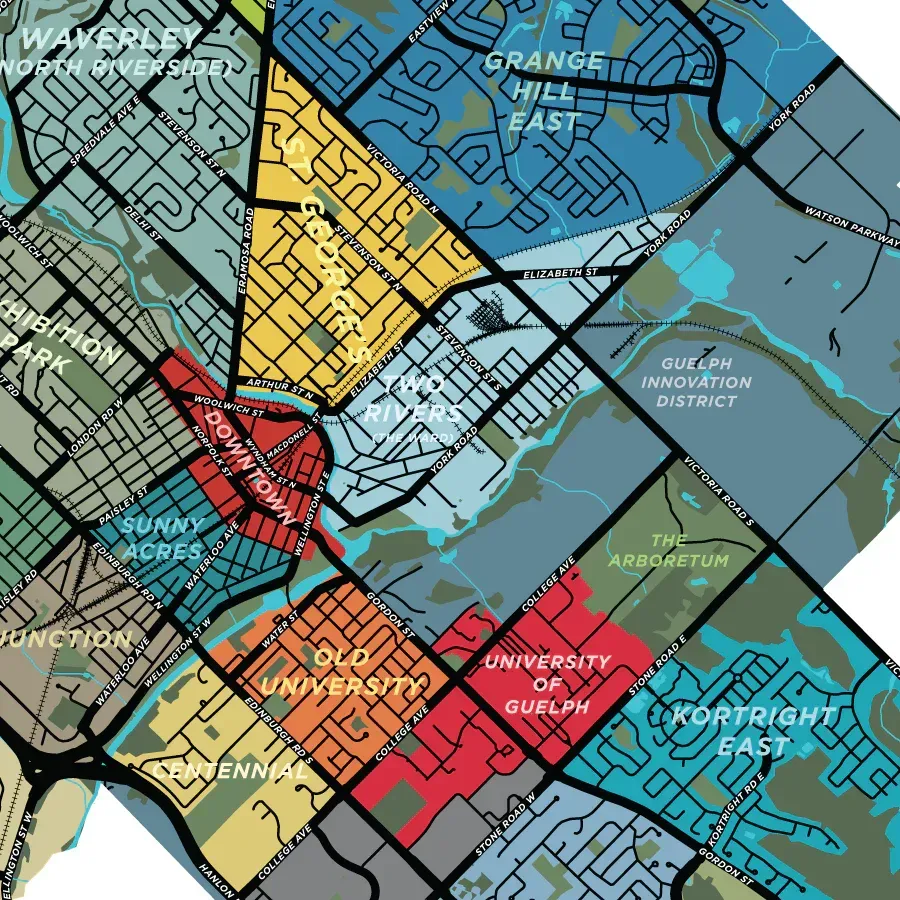
Picking the best Guelph neighbourhood for a family with school age kids involves a different checklist than buying as a couple or on your own. A few things are worth paying close attention to before you commit to an offer on a home in Guelph. Guelph school boundaries School boundaries come first. Two homes that look similar on paper can fall into different school catchments, and boundaries are set by the Upper Grand or Wellington Catholic boards rather than by neighbourhood names or postal codes. Always confirm the assigned school for a specific Guelph address rather than assuming based on what is nearby. Walkable Guelph streets for kids Walkability matters more once kids are old enough to walk or bike to school and to friends' houses. Guelph streets with sidewalks, manageable traffic, and a short walk to a park tend to hold their value well because they are in steady demand from other families with the same priorities. It is also worth visiting a Guelph neighbourhood at different times of day. A street that feels quiet on a weekday afternoon showing can feel very different at school pickup time or on a Saturday morning when kids are out playing. Driving through after school lets you see whether a street actually has other kids around, which matters more to most families than square footage. Proximity to community centres, libraries, and after school programs is another factor that is easy to overlook during a showing but matters within the first few months of living somewhere. Guelph has a good spread of these across the city, but the distance from your front door changes how often you actually use them. If you are house hunting in Guelph with school boundaries and family routines in mind, I can help you build a shortlist that fits both your budget and your kids' day to day. It is one of the areas where local knowledge makes a real difference.

Guelph and the surrounding towns lean into fall the way some cities lean into summer, and fall fairs near Guelph are a big part of that. If you are new to the area or just have not made it out to these events before, here is what is worth putting on the calendar. Fergus Fall Fair 2026 The Fergus Fall Fair is the big one nearby, running September 18 to 20 at the Centre Wellington Community Sportsplex. It is one of the oldest fairs in Ontario, with truck and tractor pulls, livestock shows, a midway, and exhibit halls full of local produce and crafts. It is a short drive from Guelph and makes for a full day out with kids or a quieter evening visit if you are going without them. Guelph Farmers Market in the fall Closer to home, the Guelph Farmers' Market continues into the fall with produce that shifts toward apples, squash, and the first pumpkins of the season. It is a good weekly stop if you want a sense of the local food scene beyond the grocery store. For families who just relocated to Guelph, events like these are an easy way to meet people and get a feel for the community beyond your own street. Fall fairs in particular tend to draw families from all over the region, so they are a good chance to talk to neighbours from towns you might not otherwise visit. If community and small town charm are part of what drew you to consider Guelph or the surrounding area, I would love to talk about which Guelph neighbourhoods tend to have that feel year round, not just during fair season.

Moving to Guelph with kids is a different project than moving on your own, and doing it before the school year starts adds a hard deadline to the process. Here is roughly how it plays out for families who want to be settled in a Guelph home before the Upper Grand District School Board's September 8, 2026 start date. When to start your Guelph home search Ideally, an accepted offer is in place by early July. That gives enough runway for financing, inspections, and closing to wrap up by early August, leaving a few weeks to unpack, register your kids at their new Guelph school, and get familiar with the neighbourhood before the first day. Families who start their home search in July often end up closing right around the point where school registration deadlines start to matter. Closing in late August If your timeline is tighter, closing in mid to late August can still work, but it means registering kids for school almost immediately after taking possession. Most schools can accommodate this, though it helps to call ahead and confirm what documents you will need, since requirements can vary between the Upper Grand board and the Wellington Catholic board. School bus eligibility in Guelph One thing families sometimes overlook is transportation. Bus eligibility is based on your address and the school you are assigned to, and there are cutoff dates for guaranteed bus service in September. If you are moving into a new catchment area, it is worth checking bus eligibility as soon as you have an address, not after you have already unpacked the last box. If you are working against a September deadline and want a real sense of what is achievable in your timeline, reach out and we can map out a plan that accounts for financing, closing, and the school calendar together.
Spring gets most of the attention in the Guelph real estate market, but September has quietly become one of the better months to buy or sell a home in Guelph. Families who wait until school starts to sort out housing often assume they missed their window, but the opposite tends to be true. Fewer lookers, more serious buyers Once the summer vacation crowd clears out, the buyers left in the Guelph housing market in September are usually serious. They are people who need to move for a job, a growing family, or a lease that is ending, not people casually browsing open houses on a Sunday afternoon. That means fewer lookers and more genuine offers for sellers, and less competition for buyers who are ready to act. More Guelph homes for sale after Labour Day Inventory also tends to refresh in September. Sellers who held off listing over the summer, whether for vacations, renovations, or simply waiting for cooler weather, often bring their Guelph homes to market once Labour Day passes. That gives buyers a wider pool of options than they had in the quieter weeks of July and August, without the frenzy of the spring market. For sellers, September listings photograph well. The lawns are still green, the light is good, and buyers touring Guelph homes are picturing themselves settled in before the holidays. Homes that go on the market in the first two weeks of September also benefit from buyers who want to close before winter, which can shorten negotiation timelines. If you have been sitting on a decision about listing your Guelph home or have been waiting for the right moment to start looking, September is worth a serious conversation. Market conditions shift throughout the year, and I can walk you through what is happening in Guelph real estate right now so you can decide with real information instead of guesswork.